Yesterday, I slept in about an hour – again. I’ve been having a glitch or two getting to sleep, so that when the alarm goes, I’m not ready to get up. I do realize this is a self-sustaining thing … but it has happened before and usually resolve within a week. I refuse to fret about it – I only mention it in case anyone has noticed I’m running a little late on comment replies. It’s not to worry.
Cartoon –
Short Takes –
Just Security – Trump Associate’s Stated Plan to Publicly Release “Declassified” Documents
Quote – As this article was going to press, ABC News published a report that weeks before the Mar-a-Lago search, former President Donald Trump’s associate Kash Patel “vowed to retrieve classified documents from the National Archives and publish them on his website.” If that scheme involved Trump himself and the Mar-a-Lago documents, it could have significant legal implications for the Justice Department’s ongoing criminal investigation. Any plan to release the documents could potentially trigger specific elements of the Espionage Act and other criminal statutes designed with the core purpose of preventing unlawful dissemination of classified and other sensitive government documents. As I discuss below, credible evidence of such a plan also would likely factor into the Justice Department’s decision on whether to bring criminal charges. Click through for details. “Just Security” you might say is a specialty news website. I’m linking to their mission statement. (I also bookmarked then, since they don’t call attention to themselves – they just quietly analyze.
Letters from an American – August 20,2022
Quote – When former president Trump withdrew the U.S. from the Trans-Pacific Partnership, he left the participants to continue without the U.S., which they did as the Comprehensive and Progressive Agreement for Trans-Pacific Partnership (CPTPP). He also left open the way for a free trade deal in the region dominated by China, called the Regional Comprehensive Economic Partnership Agreement, or RCEP, which went into effect on January 1, 2022. This left the Biden administration with two politically poor choices: try to reestablish U.S. participation in the region through the CPTPP, which would have been hotly contested at home and thus unlikely to get through Congress, or let China dominate the region, with damaging long-term effects. So the administration found a third way. Click through for background. This is kind of a compliation of who has visited Taiwan from the United States recently, and when, and under what circumstances (not what you probably think from the press coverage.) Also, other recent history, including Trump**’s destructive actions (in my quote).
Brian Bengs has received 1.4 million (as I type – it’s probaby a lot more now) views for this ad
Steve Schmidt – Friday reflections: the lie and the truth aren’t equal {Steve is singing my song – “Fair and balanced” should NEVER be the primary goal of journalism, because it reeks of “bothsiderism.” There should be only ONE primary journalistic goal: TRUTH.}
“Mrs F” – might need admin for this one
Beau – Let’s talk about the damage assessment about Trump’s docs….
Yesterday, I basically tried to keep things slow and calm. It was a pill-organizing weekend, and everything runs out at different times, so there is literally never an occasion when I don’t have to run to another room for a new bottle of something OTC or order a prescription renewal – I generally do that in advance for the following fortnight so I can at least get the bottles filled and capped without interruption (otherwise this klutz would be knocking them over and using choice language.)
Cartoon –
Short Takes –
The 19th – Magnolia Mother’s Trust marks a history-making three cycles of paying Black mothers $1,000 a month
Quote – The Magnolia Mother’s Trust is now the longest-running guaranteed income program in the United States. But the program, which gives Black mothers in Jackson, Mississippi, $1,000 a month for one year, no strings attached, was never meant to last forever. “I don’t think that’s the systems change we need,” said Aisha Nyandoro, CEO of Springboard Opportunities, which runs Magnolia Mother’s Trust and provides programs and services to families that live in federally subsidized affordable housing. Instead, the goal of the trust is to model what could be, in a more just and fair society. CLick through for story. If Republians really wanted a world with more happy and healthy people, this is what they would be doing (which of coursethey don’t.) Likewise, if they really wanted a world of people who would fall easily into categories and be content with that, they should be emulating Brave New World – the ohly dystopia I’m aware of in which the characters aren’t aware that it’s a dystopia. But Republicans don’t want that either. They aren’t happy unless someone is getting hurt.
Vice – Scientists Achieve the Impossible, Safely Destroy Toxic ‘Forever Chemicals’
Quote – In a new paper published [this month] in the journal Science, a team of researchers have uncovered a new way to dispose of a class of these chemicals under comparatively mild conditions, including ambient pressure and temperatures as low as 176 degrees Fahrenheit. William Dichtel is a lead author on the paper and a professor of chemistry at Northwestern University. He said in a press conference about the work on Tuesday that one of the exciting benefits of this discovery is that the reaction leaves no damaging products in its wake. “We were pleased to find a relatively low temperature, low energy input method where the one specific portion of these molecules falls off and sets off a cascade of reactions that ultimately breaks these PFAS compounds down to relatively benign products including fluoride ions… that are in many cases found in nature already and do not pose serious health concerns.” Click through for background and more info. Nobody saw this coming – even the scientists were pleasantly surprised. And good news is always welcome.
Experts in autocracies have pointed out that it is, unfortunately, easy to slip into normalizing the tyrant, hence it is important to hang on to outrage. These incidents which seem to call for the efforts of the Greek Furies (Erinyes) to come and deal with them will, I hope, help with that. As a reminder, though no one really knows how many there were supposed to be, the three names we have are Alecto, Megaera, and Tisiphone. These roughly translate as “unceasing,” “grudging,” and “vengeful destruction.”
“Prosecuting a president is divisive and sometimes destabilizing” – well, no – ahem – no lie, Sherlock. There are lots of people saying that. What very few seem to be saying, including those who believe Donald Trump** should be prosecuted, is that it isn’t so much the prosecution which is divisive and/or destablilzing is the brute fact of a president being a criminal. In other words, let’s face it – NOT prosecuting a criminal president is divisive and sometimes destabilizing.
Some nations have prosecuted former presidents – some have even prosecuted serving presidents (impeaching them first would be nice, but isn’t always possible – as few know better than Americans who have been around since before 2016.) But here are some examples, and some considerations.
==============================================================
Prosecuting a president is divisive and sometimes destabilizing – here’s why many countries do it anyway
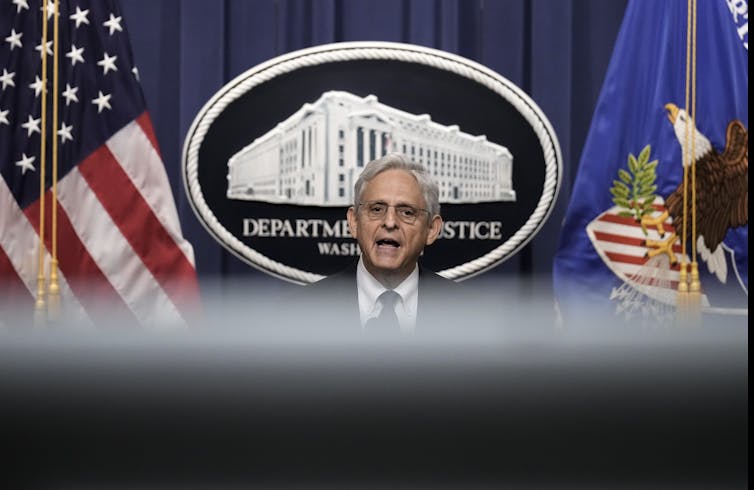
U.S. Attorney General Merrick Garland addresses the FBI’s recent search of former President Donald Trump’s Mar-a-Lago residence, where classified information was reportedly seized. Drew Angerer/Getty Images
While charging a former president with a criminal offense would be a first in the United States, in other countries ex-leaders are routinely investigated, prosecuted and even jailed.
At first glance, prosecuting current or past top officials accused of illegal conduct seems like an obvious decision for a democracy: Everyone should be subject to the rule of law.
But presidents and prime ministers aren’t just anyone. They are chosen by a nation’s citizens or their parties to lead. They are often popular, sometimes revered. So judicial proceedings against them are inevitably perceived as political and become divisive.
Destabilizing prosecutions
This is partly why U.S. President Gerald Ford pardoned Richard Nixon, his predecessor, in 1974. Despite clear evidence of criminal wrongdoing in the Watergate scandal, Ford feared the country “would needlessly be diverted from meeting (our) challenges if we as a people were to remain sharply divided over” punishing the ex-president.
Public reaction at the time was divided along party lines. Today, some now see absolving Nixon as necessary to heal the nation, while others believe it was a historic mistake, even taking Nixon’s deteriorating health into account – if for no other reason than it emboldens future impunity of the kind Trump is accused of.
Our research on prosecuting world leaders finds that both sweeping immunity and overzealous prosecutions can undermine democracy. But such prosecutions pose different risks for older democracies such as France and the U.S. than they do in younger democracies like South Africa.
Mature democracies
Strong democracies are usually competent enough – and the judicial system independent enough – to prosecute politicians who misbehave, including top leaders.
Sarkozy is France’s second modern president to be found guilty of corruption, after Jacques Chirac in 2011 for kickbacks and an attempt to bribe a magistrate. The country didn’t fall apart after either conviction. Some observers, however, say that Sarkozy’s three-year prison sentence was too harsh and politically motivated.
Sarkozy leaves court after being found guilty of corruption and influence peddling in 2021. Kiran Ridley/Getty Images
Did these prosecutions deter future leaders from wrongdoing? For what it’s worth, Korea’s two most recent presidents have so far kept out of legal trouble.
Overzealous prosecution versus rule of law
Even in mature democracies, prosecutors or judges can abuse prosecutions. But overzealous political prosecution is more likely, and potentially more damaging, in emerging democracies where courts and other public institutions may be insufficiently independent from politics. The weaker and more beholden the judiciary, the easier it is for leaders to exploit the system, either to expand their own power or to take down an opponent.
Depending on one’s perspective, Brazil’s crisis reveals that nobody is above the law or that the government is incorrigibly corrupt – or both. With such confusion, it becomes easier for politicians and voters to view leaders’ transgressions as a normal cost of doing business.
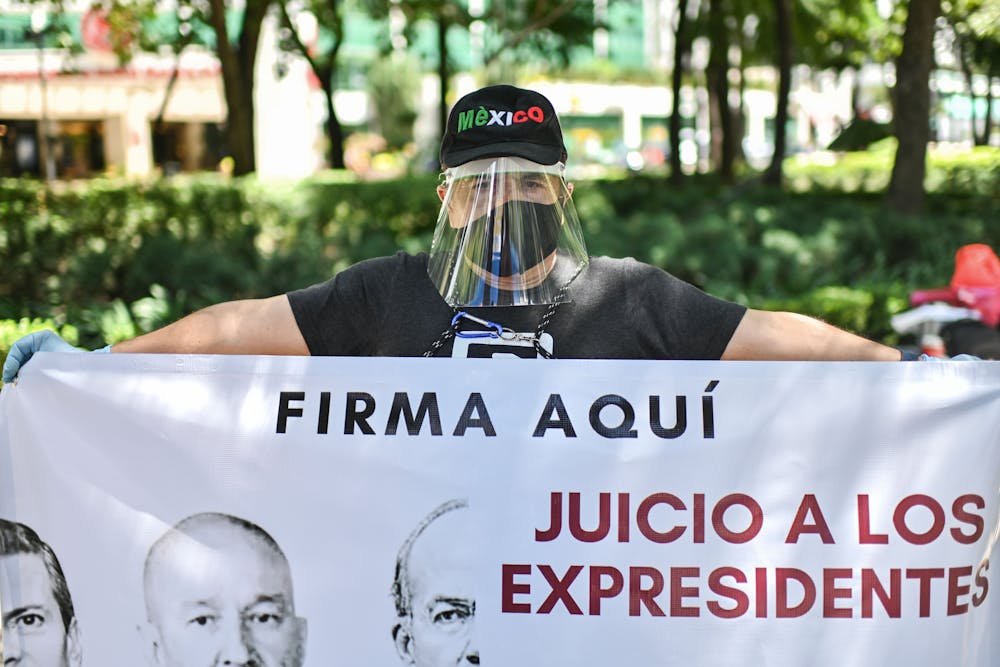
Historically, Mexico has taken a different approach to prosecuting past presidents: It doesn’t.
During the 20th century, Mexico’s ruling Institutional Revolutionary Party, or PRI, established a system of patronage and corruption that kept its members in power and other parties in the minority. While making a show of going after smaller fish for petty indiscretions, the PRI-run legal system wouldn’t touch top party officials, even the most openly corrupt.
Impunity kept Mexico stable during its transition to democracy in the 1990s by placating PRI members’ fears of prosecution after leaving office. But government corruption flourished, and with it, organized crime.
Protecting authoritarians – including those who oversaw human rights violations – may seem contrary to democratic values, but many transitional governments have decided it is necessary for democracy to take root.
That’s the bargain South Africa struck as apartheid’s decades of segregation and human rights abuses ended in the early 1990s. South Africa’s white-dominated government negotiated with Nelson Mandela’s Black-led African National Congress to ensure outgoing government members and supporters would avoid prosecution and largely retain their wealth.
Corruption is a problem, too, as former President Zuma’s prosecution for lavish personal use of public funds shows. But South Africa has a famously independent judiciary. Despite pushback from some African National Congress stalwarts and several legal appeals, Zuma’s prosecution continues. And it may yet deter future misdeeds.
How mature is mature?
Israel is partly a testament to the rule of law – and partly a cautionary tale about prosecuting leaders in democracies.
Israel didn’t wait for Prime Minister Benjamin Netanyahu to leave office to investigate wrongdoing. But the court process was fraught with delays, in part because Netanyahu used state power to resist what he called a “witch hunt.”
The trial triggered protests by his Likud party. Netanyahu tried unsuccessfully to secure immunity and stall. He was even reelected while under indictment, and his trial is not over yet.
If Trump is criminally prosecuted, the process would reveal something fundamental about American democracy. Whatever the outcomes, they would be a matter of both law – and politics.
============================================================== Alecto, Megaera, and Tisiphone, I heard an anecdote once – supposedly a true one, and it very well could be – about a woman who had not gone to college upon graduation from high school, but had dreamed of a career which required a college degree. Later in life, with all her children grown and out of the family home, she was talking to a friend about this, and mentioned her discouragement of thinking, “If I start now, then when I graduate, I’ll be sixty.” He friend gently asked, “And how old will you be in four years if you don’t start college now?”
That is how it seems to me about the question of prosecuting Trump**. Assuming there is sufficient court evidence (I say that because there is plenty of evidence visible to all), would prosecuting not be at least as likely to bring about unity as further division? I mean, how much more divided can we get?
Yesterday, the opera was “Boris Godunov” by Mussorgsky, from the Vienna State Opera. The advance promo described it as a combination of historical drama and psychological study, the main character being “hauned by [thoughts of] the child he murdered to gain the throne.” Well, Mussorgsky may well have seen it that way, and if so, it’s to his credit. But all one has to do today in the US is look around to see that people who will do anything for money and power (especially power) are never hauntes by thoughts of people whom they hurt on the way up.The only thing that troubles them is fear of being caught out and facing consequences. Interpreted that way the opera does, I think, work (and it also helps if one doesn’t know any more Russian than “da” and “nyet.”) I doubt, however, that Putin would be impressed. Fear of being caught implies fear of consequences, and he appears to be pretty well insulated from consequences.
Cartoon –
Short Takes – another “News of the Weird” day
Axios – Denver Art Museum brings back its “Singing Sinks” exhibit
Quote – The faucets — found in the bathrooms of the Sie Welcome Center on Level 2 of the freshly renovated Martin Building — belt out a harmonious chorus of “Row Row Row Your Boat” as you wash your hands. Each sink is equipped with an interactive sound system that pipes in the music through the drain, offering a “voice in the plumbing” effect. Click through for background. Silly as this may sound, it has won the museum an award for “Best Museum Bathrooms.”
Daily Beast – Bodies Discovered in Suitcases by New Zealand Family Are Children
Quote – Vaaelua said initial postmortem examinations of the bodies revealed the remains found in two suitcases are that of two primary school-aged children. “Early indications suggest these children may have been deceased for a number of years before being found last week,” Vaaelua said in a statement obtained by The Daily Beast. Click through for story. Very little is actually known, and they are being cagey with what they do know until they can establish a next of kin