Yesterday, Lindsey Graham introduced a bill in the Senate to ban abortion at the federal level. This irritates me… but it doesn’t alarm me, because if they really wanted to pass it, they would wait until they have a majority in both houses, and some of them think that is going to be soon. This is political theater. And it is more likely to backfire than not. Also I need to give you all an update on James. the amputation has happened (he didn’t say anything about the process, so I’m going with “No news is good news.”) He is already confident that he made the right choice. Now the recovery begins. Incidentally, I have an appointment myself today – just for an annual checkup. Oh, and one other thing – the candidate running against Boebert is Adam Frisch. I’m not hopefull of beating Buck or Lamborn, bothe of whom are well established, but I think Boebert might be beatable. If you check Adam out, let us know what you think.
Cartoon –
Short Takes –
Robert Reich – Who will bear the pain?
Quote – Get ready. The war on inflation is about to get ugly…. Who will bear this pain? Not corporate executives. Not Wall Street. Not big investors. Not the upper-middle class. The draftees into the war on inflation will be — already are — lower-wage workers. As the economy cools due to interest rate hikes, they will be first to be fired as the economy plunges and the last to be hired. The Fed is obsessing about a “wage-price” spiral — wage gains pushing up prices — when it should be worried about a profit-price spiral. Click through for full article. All of this could be avoided if we used a different benchmark for the economy than the stock market. Usng the stock market is a little bit like doctors using the health of peole’s genitals as an indicator of their overall health. Not really representative.
AP News – Ken Starr, whose probe led to Clinton impeachment, dies
Quote – Ken Starr, a former federal appellate judge and a prominent attorney whose criminal investigation of Bill Clinton led to the president’s impeachment and put Starr at the center of one of the country’s most polarizing debates of the 1990s, has died at age 76, his family said Tuesday. Starr died at a hospital Tuesday of complications from surgery, according to his former colleague, attorney Mark Lanier. He said Starr had been hospitalized in an intensive care unit in Houston for about four months. Click through for full obit. Please don’t dance in the streets. It’s tacky. And if you have any Republican neighbors you could be putting yourself in harm’s way.
Yesterday, I added a video to the video thread after it had already published, because the breaking news in it appeared to me to be significant at lease. It was regarding an unplanned trip to DC made by Trump, in his jet, oddly dressed, with no publicity. The trip was late Sunday afternoon, and as of late Monday afternoon, there was still no word about it from the Trump** camp. The way Trump** broadcasts all of his movements down to the tiniest detail, the absence of publicity alone suggests that, whatever the trip was for, it must have been for some reason that was bad news for Trump**. And bad news for him is good news for us. That and one other thing inspired me so that I finished the September cartoons. (The other thing that cheered me was what Nameless posted about.)
Cartoon –
Short Takes –
Salon – Biden’s speech worked: Nearly 6 in 10 Americans agree MAGA is a threat to democracy
Quote – President Joe Biden gave a speech… [which] led to a great deal of media worrying about whether Biden’s speech was “divisive” or could backfire by recasting the fight to save democracy in “partisan” terms. There was reason to be worried. Americans tend to distrust politicians, viewing their public proclamations as political noise better dismissed than taken seriously. But in this case, it appears Biden’s choice to give the speech worked to focus voter attention on the very real threat to democracy posed by Trump and the MAGA movement. Click through – Of course he wasn’t going to reach active MAGA pushers, and eventually we shall have to deal with them. For now, the important thing is to get ALL non-MAGAs aware of the clear and present danger it reppresents.
CPR News – 4 things we learned from the first-ever release of data that shows how Colorado DAs prosecute cases
Quote – Eight district attorneys across the state — some representing rural areas, some from suburban districts and two representing Denver and Aurora — voluntarily participated in a year-long data project to shed some light on the secrecy behind prosecutions across the state in hopes of seeing how their offices could improve how they operate. The data, linked on eight different prosecutor websites, reveals some differences in how prosecutors treat white defendants and defendants of color, including Black and Hispanic. Click through for full story. To me,though the results are predictiable (and not great), the most hopeful thing about this story is that the participants instigated it themselves because that wanted to/thought they should be more transparent. That is hopeful.
Yesterday, I visited Virgil, who returns all greetings. Neither of us had a lot to say, but we enjoyed each others company. The drives down and back were uneventful, and I seem to have finally mastered the difference in what one can and cannot bring in and what one must or need not present between here and all the other facilities. I still have a couple of questions (in my mind) about the dress code, which is visibly more lenient here. But since it’s easy to prepare by the stricter rules, I’ll probably just do that unless a need arises.
Cartoon –
Short Takes –
PolitiZoom – Laurence Tribe – Trump Must be Charged with Espionage and Obstruction in Washington D.C.
Quote – National Defense and security forum Just Security along with Philip Lacovara and Dennis Aftergut, reminds us that drumpf’s all-star lineup of corrupt judges in Florida and the 11th Circuit Court of Appeals, many of who he appointed for the sole purpose of getting him out of hot water when the nation inevitably learned of his crimes, should not be a factor in the DOJ’s prosecution of der Gropinfuhrer for his theft of Nation Security secrets, but that The Superior Court of the District of Columbia, the venue with jurisdiction over Washington D.C., where the crime actually occurred, should be where drumpf is indicted and tried. Click through for full article. It’s not just the judges … it’s also the juries. A fair jury is going to be much easier to seat in D.C. than in Florida.
The Warning – They saved the Capitol and killed the enemy
Quote – The passengers and crew of United 93 were combatants. They represented the greatest virtues of patriotism and sacrifice in a defining moment. They defended their country and should be recognized and decorated accordingly…. There is something called a brevet. It is arcane and no longer in use [JD note – I believe it may still be available for certain battlefield promotions – emergency use, as it were], but has a long tradition in the US military. It should be used again to properly recognize the fierceness, valor and sacrifice of the men and women of United 93 who were the equals of the men who stood their ground at Lexington, Bastogne and Gettysburg. They died as Americans fighting back against a foreign enemy. They huddled, organized, voted and formed an American armed force, and attacked the enemy and killed him. They saved the Capitol of the United States and thousands of lives. Click through for story and passion. I agree with him. I’m an unpaid subscriber, so usually I get a half or a third of his articles, but this one arrived in full, and appears to be available in full at his site for all, including non-subscribers.
Glenn Kirschner – Bannon indicted again; DOJ appeals “special master” ruling; former US Attorney exposes Trump & Barr (the sound is so poor on this that everyone will need the CC. Not only is the volume about half or less of usual, bu there’s a slight echo. I realize they are tweaking the studio … and have invited comments on that … so if anyone is a YouTube member, you might just comment on the sound.)
Meidas Touch – Steve Bannon SURRENDERS in NY as he is INDICTED on new STATE CRIMINAL CHARGES
The Lincoln Project – Rick Reacts – Trump**’s Meltdown
Thom Hartmann – This Constitutional Law Says Trump & His Traitors CAN’T Hold Office
Rocky Mountain Mike – Happiness Is A Jailed Trump
Beau – Let’s talk about New Mexico, Jan 6, and the 14th Amendment…
Experts in autocracies have pointed out that it is, unfortunately, easy to slip into normalizing the tyrant, hence it is important to hang on to outrage. These incidents which seem to call for the efforts of the Greek Furies (Erinyes) to come and deal with them will, I hope, help with that. As a reminder, though no one really knows how many there were supposed to be, the three names we have are Alecto, Megaera, and Tisiphone. These roughly translate as “unceasing,” “grudging,” and “vengeful destruction.”
“It ain’t what you don’t know that gets you into trouble. It’s what you know for sure that just ain’t so.” This quote is credibly attributed to Mark Twain (since he said it, I’m sure he would not object to me doubting the attribution a little. So much is attributed to so few apeakers.) This is at least as true in politics as it is in any other endeavor. All one needs to do is look at any habitual Fox viewer to recognize that. And I’m sure no one will be surprised to learn that Dunning-Kruger also applies. But what people think and do in their life in general usually affects no one but themselves, and possibly a few people close to them whether personally or professionally. What people do in the voting booth affscts everyone else in the nation, as well as many all over the world.
==============================================================
Americans think they know a lot about politics – and it’s bad for democracy that they’re so often wrong in their confidence
As statewide primaries continue through the summer, many Americans are beginning to think about which candidates they will support in the 2022 general election.
Voters must navigate angry, emotion-laden conversations about politics when trying to sort out whom to vote for. Americans are more likely than ever to view politics in moral terms, meaning their political conversations sometimes feel like epic battles between good and evil.
But political conversations are also shaped by, obviously, what Americans know – and, less obviously, what they think they know – about politics.
In recent research, I studied how Americans’ perceptions of their own political knowledge shape their political attitudes. My results show that many Americans think they know much more about politics than they really do.
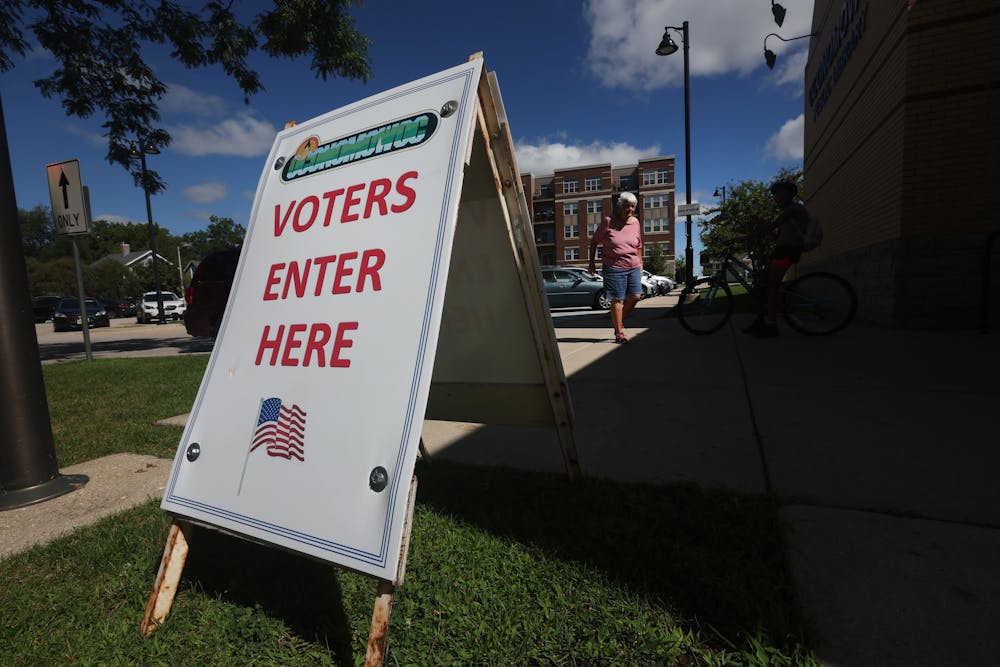
Voters arrive to cast their primary ballots at a polling place on Aug. 9, 2022, in Oconomowoc, Wisconsin. Scott Olson/Getty Images
Knowledge deficit, confidence surplus
Over the past five years, I have studied the phenomenon of what I call “political overconfidence.” My work, in tandem with other researchers’ studies, reveals the ways it thwarts democratic politics.
Political overconfidence can make people more defensive of factually wrong beliefs about politics. It also causes Americans to underestimate the political skill of their peers. And those who believe themselves to be political experts often dismiss the guidance of real experts.
Political overconfidence also interacts with political partisanship, making partisans less willing to listen to peers across the aisle.
The result is a breakdown in the ability to learn from one another about political issues and events.
A ‘reality check’ experiment
In my most recent study on the subject, I tried to find out what would happen when politically overconfident people found out they were mistaken about political facts.
To do this, I recruited a sample of Americans to participate in a survey experiment via the Lucid recruitment platform. In the experiment, some respondents were shown a series of statements that taught them to avoid common political falsehoods. For instance, one statement explained that while many people believe that Social Security will soon run out of money, the reality is less dire than it seems.
My hypothesis was that most people would learn from the statements, and become more wary of repeating common political falsehoods. However, as I have found in my previous studies, a problem quickly emerged.
The problem
First, I asked respondents a series of basic questions about American politics. This quiz included topics like which party controls the House of Representatives – the Democrats – and who the current Secretary of Energy is – Jennifer Granholm. Then, I asked them how well they thought they did on the quiz.
Many respondents who believed they were top performers were actually among those who scored the worst. Much akin to the results of a famous study by Dunning and Kruger, the poorest performers did not generally realize that they lagged behind their peers.
Of the 1,209 people who participated, around 70% were overconfident about their knowledge of politics. But this basic pattern was not the most worrying part of the results.
The overconfident respondents failed to change their attitudes in response to my warnings about political falsehoods. My investigation showed that they did read the statements, and could report details about what they said. But their attitudes toward falsehoods remained inflexible, likely because they – wrongly – considered themselves political experts.
But if I could make overconfident respondents more humble, would they actually take my warnings about political falsehoods to heart?
Poor self-assessment
My experiment sought to examine what happens when overconfident people are told their political knowledge is lacking. To do this, I randomly assigned respondents to receive one of three experimental treatments after taking the political knowledge quiz. These were as follows:
Respondents received statements teaching them to avoid political falsehoods.
Respondents did not receive the statements.
Respondents received both the statements and a “reality check” treatment. The reality check showed how respondents fared on the political quiz they took at the beginning of the survey. Along with their raw score, the report showed how respondents ranked among 1,000 of their peers.
For example, respondents who thought they had aced the quiz might have learned that they got one out of five questions right, and that they scored worse than 82% of their peers. For many overconfident respondents, this “reality check” treatment brought them down to earth. They reported much less overconfidence on average when I followed up with them.
Finally, I asked all the respondents in the study to report their levels of skepticism toward five statements. These statements are all common political falsehoods. One statement, for example, asserted that violent crime had risen over the prior decade – it hadn’t. Another claimed the U.S. spent 18% of the federal budget on foreign aid – the real number was less than 1%.
I expected most respondents who had received my cautionary statements to become more skeptical of these misinformed statements. On average, they did. But did overconfident respondents learn this lesson too?
Those who believe themselves to be political experts often dismiss the guidance of real experts. IvelinRadkov/iStock/Getty Images
Reality check: Mission accomplished
The results of the study showed that overconfident respondents began to take political falsehoods seriously only if they had experienced my “reality check” treatment first.
While overconfident respondents in other conditions showed no reaction, the humbling nature of the “reality check,” when they realized how wrong they had been, led overconfident participants in that condition to revise their beliefs. They increased their skepticism of political falsehoods by a statistically significant margin.
Overall, this “reality check” experiment was a success. But it reveals that outside of the experiment, political overconfidence stands in the way of many Americans’ ability to accurately perceive political reality.
The problem of political overconfidence
What, if anything, can be done about the widespread phenomenon of political overconfidence?
While my research cannot determine whether political overconfidence is increasing over time, it makes intuitive sense that this problem would be growing in importance in an era of online political discourse. In the online realm, it is often difficult to appraise the credibility of anonymous users. This means that false claims are easily spread by uninformed people who merely sound confident.
To combat this problem, social media companies and opinion leaders could seek ways to promote discourse that emphasizes humility and self-correction. Because confident, mistaken self-expression can easily drown out more credible voices in the online realm, social media apps could consider promoting humility by reminding posters to reconsider the “stance,” or assertiveness, of their posts.
While this may seem far-fetched, recent developments show that small nudges can lead to powerful shifts in social media users’ online behavior.
For example, Twitter’s recent inclusion of a pop-up message that asks would-be posters of news articles to “read before tweeting” caused users to rethink their willingness to share potentially misleading content.
A gentle reminder to avoid posting bold claims without evidence is just one possible way that social media companies could encourage good online behavior. With another election season soon upon us, such a corrective is urgently needed.
============================================================== Alecto, Megaera, and Tisiphone, the real estate business is supposed to come down to three things – location, location, and location. I’m tempted to say that fixing this issue comes down to civics, civics, and civics – but actually it would probably be more accurate to cite general education, critical thinking, and fact checking. Everything that the authoritarian right wing does not want.
In a sense, it is true that voting is not the only way, and in some ways not even the best way, to bring about progress. Before progress can happen, public opinion must be changed. But we are at a time in the history of our nation when pubic opinion is mostly with us, but the elected officials are not. In that impasse, only voting can help. We must, in spite of gerrymanding and other legal or even constitutional ways of rigging, vote people in who actually represent majority views, and vote people out who oppose them. Then perhaps we can make some actual progress.
Yesterday’s radio opera was “I Puritani” by Vincenzo Bellini. Bellini was a composer of “bel canto” opera (Italian for beautiful singing), a style from the early 19th century which was pretty much out of fashion until brough back into prominence by Maria Callas and Joan Sutherland in the 1950’s and ’60’s, and has been part of the standard repertory since. Of course all opera is supposed to have beautiful singing, but bel canto specifically refers to a style which has lots of vocal ornaments and very little key changes or complexity. So in one way it’s virtuosic, but in another it’s simple. Opera singers say that singing it is good for the voice, compared to even mid-19th-cebtury like Verdi, but certainly compared to early 20th century like Puccini (“verismo”) and especially early-to-mid 20th century like Berg amd Schoenberg. It is filled with lovely melodies that leave listeners humming – in their minds, because unless you are trained you likely can’t produce all the twists and turns, especially at the tempos some of them are. Next week’s opera – in fact the next four weeks’ operas – were recorded in China – but only the last one will be in Chinese. The first three will be in French, Czech, and German respectively.
Cartoon – 11 0911Cartoon.jpg
Short Takes –
Letters frm an American – September 8, 2022
Quote – On this day in 1974, President Gerald Ford gave former president Richard M. Nixon “a full, free, and absolute pardon…for all offenses against the United States which he…has committed or may have committed or taken part in” during his time in the presidency. In the pardon proclamation, Ford said he issued the pardon to help the nation heal from the trauma of the Watergate scandal. A trial would “cause prolonged and divisive debate over the propriety of exposing to further punishment and degradation a man who has already paid the unprecedented penalty of relinquishing the highest elective office of the United States.”
Ford’s pardon of Nixon removed from our democratic system the principle that all of us are accountable to the same laws. Click through for full letter. There was an episode of Antiques Roadshow to which someone brought a letter from Gerald Ford, written before he was Presient or Vice Preident, but not too long before that. It was written to his former first grade teacher, who he had just learned used to call him “Naughty little Gerry Ford.” Maybe she was right all along.
Civil Discourse – DOJ’s Motion For A Stay Explained
Quote – DOJ’s tone is respectful throughout, but the government does not mince words when it comes to arguing that the judge’s order is wrong, as in, missed the boat completely kind of wrong. And in delicate, polite tones it clarifies the precise nature of the damage she, a lone federal judge in Florida, is poised to do to our national security. This is exactly the tone experienced appellate litigators take when they are about to pillory a lower court’s ruling, which is what DOJ does in its motion. Click through. Legal documents are usually written at a JD reading level. Vance interprets this at about a foourth grade reading level, so it should be pellucidly clear (or as much so as possible allowing for missing facts.) Because I get her newsletter, I have not tried navigating the site, but if it’s easy, she has two, possibly three columns after this (just ignore the stuff about knitting.)