Yesterday, My drive was pretty uneventful except for some pretty heavy rain on the way down. It didn’t last long, but it gave the wipers a challenge on their highest setting while it lasted, and affected visibility. We played four games of Scrabble, not competetively, but with the aim of using allt he letters legitimately – and succeeded on all but thelast one. We were left with 8 vowels between us and the poard so tight that there was really no place to put any of them. He returnes all greetings. Today, both short takes are from substack – I apologize for that, but both of them include Tulsa (the Greenwood massacre) in their contents, and that anniversary is already a few days old.
Cartoon –
Short Takes –
The Good in Us – Black Wall Street
Quote – Since the end of the Civil War, the thing most likely to incite white violence against emancipated Black citizens was their success. Giving Black Americans full rights, beyond the freedom that had so grudgingly been granted to them after the Union prevailed, proved to be a bridge too far for many whites—even Northern Republicans…. In retrospect, it seems self-evident that the driver behind the essential re-enslavement of Black people after Reconstruction was Black prosperity. Click through for full column. Even before I realized how horribly many massacres there have been in the US, I had begun to realize that, although the impulse for anyone in a marginalized group is to demonstrate their own worth, that is often unsuccessful at best and dangerous at worst. But she says it better than I can.
Letters from an American – June 1, 2023
Quote – In other economic news, the Biden administration today announced actions designed to address racial bias in the valuation of homes. This sounds sort of in the weeds for administration action, I know, but it is actually an important move for addressing the nation’s wealth inequality…. Homeownership is the most important factor in creating generational wealth—that is, wealth that passes from one generation to the next—both because homeownership essentially forces savings as people pay mortgages, and because homes tend to appreciate in value…. There is a reason that the administration has centered its housing policies on June 1. This is the anniversary of the Tulsa Massacre, Click through for full article. I’m very glad the Biden administration is doing this. I hope they stay on it when it comes to actually making it happen. For more than 150 years we have trusted people to do the right thing and, frankly, that doesn’t work.
Experts in autocracies have pointed out that it is, unfortunately, easy to slip into normalizing the tyrant, hence it is important to hang on to outrage. These incidents which seem to call for the efforts of the Greek Furies (Erinyes) to come and deal with them will, I hope, help with that. As a reminder, though no one really knows how many there were supposed to be, the three names we have are Alecto, Megaera, and Tisiphone. These roughly translate as “unceasing,” “grudging,” and “vengeful destruction.”
Artificial intelligence has been around for a long time. One can argue that mechanizing arithmeical calculation is itself a form of AI, and, if so, that takes it back to Babbage in the early 1800s. Or you can go back millennia and reference the abacus. “Teaching” machines words and concepts has been longer in arriving, but that still goes back more than fifty years. Terry Winograd published the program SHRDLU in 1972, and I doubt whether he was the first. But SHRDLU was essentially designed to open up possibilities. It was far from Watson (which defeated Jeopardy champtions) and even farther from ChatGPT, which has been said to have a tendency to make up the references which it cites and the facts cited. We already have more than enough live Republicans doing that. We don’t need machines for it.
==============================================================
How can Congress regulate AI? Erect guardrails, ensure accountability and address monopolistic power
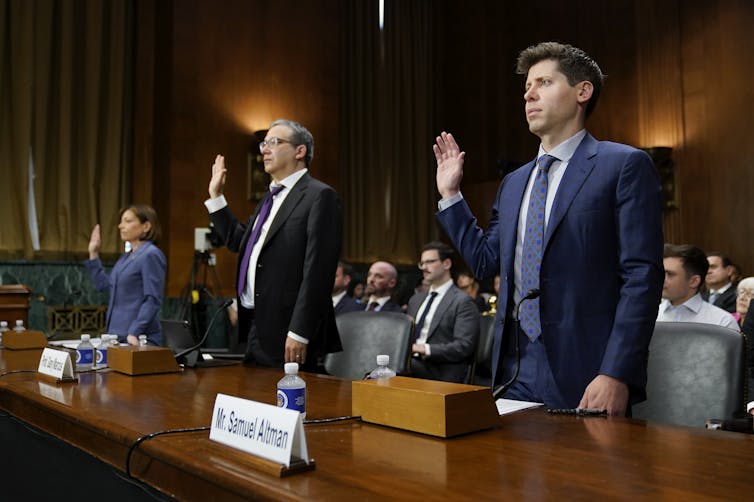
IBM executive Christina Montgomery, cognitive scientist Gary Marcus and OpenAI CEO Sam Altman prepared to testify before a Senate Judiciary subcommittee. AP Photo/Patrick Semansky
A new federal agency to regulate AI sounds helpful but could become unduly influenced by the tech industry. Instead, Congress can legislate accountability.
Instead of licensing companies to release advanced AI technologies, the government could license auditors and push for companies to set up institutional review boards.
The government hasn’t had great success in curbing technology monopolies, but disclosure requirements and data privacy laws could help check corporate power.
OpenAI CEO Sam Altman urged lawmakers to consider regulating AI during his Senate testimony on May 16, 2023. That recommendation raises the question of what comes next for Congress. The solutions Altman proposed – creating an AI regulatory agency and requiring licensing for companies – are interesting. But what the other experts on the same panel suggested is at least as important: requiring transparency on training data and establishing clear frameworks for AI-related risks.
Another point left unsaid was that, given the economics of building large-scale AI models, the industry may be witnessing the emergence of a new type of tech monopoly.
As a researcher who studies social media and artificial intelligence, I believe that Altman’s suggestions have highlighted important issues but don’t provide answers in and of themselves. Regulation would be helpful, but in what form? Licensing also makes sense, but for whom? And any effort to regulate the AI industry will need to account for the companies’ economic power and political sway.
An agency to regulate AI?
Lawmakers and policymakers across the world have already begun to address some of the issues raised in Altman’s testimony. The European Union’s AI Act is based on a risk model that assigns AI applications to three categories of risk: unacceptable, high risk, and low or minimal risk. This categorization recognizes that tools for social scoring by governments and automated tools for hiring pose different risks than those from the use of AI in spam filters, for example.
The U.S. National Institute of Standards and Technology likewise has an AI risk management framework that was created with extensive input from multiple stakeholders, including the U.S. Chamber of Commerce and the Federation of American Scientists, as well as other business and professional associations, technology companies and think tanks.
Federal agencies such as the Equal Employment Opportunity Commission and the Federal Trade Commission have already issued guidelines on some of the risks inherent in AI. The Consumer Product Safety Commission and other agencies have a role to play as well.
Cognitive scientist and AI developer Gary Marcus explains the need to regulate AI.
Licensing auditors, not companies
Though OpenAI’s Altman suggested that companies could be licensed to release artificial intelligence technologies to the public, he clarified that he was referring to artificial general intelligence, meaning potential future AI systems with humanlike intelligence that could pose a threat to humanity. That would be akin to companies being licensed to handle other potentially dangerous technologies, like nuclear power. But licensing could have a role to play well before such a futuristic scenario comes to pass.
Algorithmic auditing would require credentialing, standards of practice and extensive training. Requiring accountability is not just a matter of licensing individuals but also requires companywide standards and practices.
Experts on AI fairness contend that issues of bias and fairness in AI cannot be addressed by technical methods alone but require more comprehensive risk mitigation practices such as adopting institutional review boards for AI. Institutional review boards in the medical field help uphold individual rights, for example.
Strengthening existing statutes on consumer safety, privacy and protection while introducing norms of algorithmic accountability would help demystify complex AI systems. It’s also important to recognize that greater data accountability and transparency may impose new restrictions on organizations.
Scholars of data privacy and AI ethics have called for “technological due process” and frameworks to recognize harms of predictive processes. The widespread use of AI-enabled decision-making in such fields as employment, insurance and health care calls for licensing and audit requirements to ensure procedural fairness and privacy safeguards.
Given the lack of transparency in the training data used by these companies, AI ethics experts Timnit Gebru, Emily Bender and others have warned that large-scale adoption of such technologies without corresponding oversight risks amplifying machine bias at a societal scale.
It is also important to acknowledge that the training data for tools such as ChatGPT includes the intellectual labor of a host of people such as Wikipedia contributors, bloggers and authors of digitized books. The economic benefits from these tools, however, accrue only to the technology corporations.
Proving technology firms’ monopoly power can be difficult, as the Department of Justice’s antitrust case against Microsoft demonstrated. I believe that the most feasible regulatory options for Congress to address potential algorithmic harms from AI may be to strengthen disclosure requirements for AI firms and users of AI alike, to urge comprehensive adoption of AI risk assessment frameworks, and to require processes that safeguard individual data rights and privacy.
==============================================================
AMT, at a time and in a nation where YouTube has decided to allow videos from election deniers (including election-denying videos), AI presents another clear and present danger. We may not have more than one chnce to get it right – and even if we do get a second chance, there will likely have been damage done. There are people in Congrss, both houses, whom I would trust to make informed decisions on this. There are just not enough of them. And maybe that’s the point.
Yesterday, the radio opera was Mozart’s “Die Zauberflöte” (The Magic Flute). If you saw “Amadeus,” you probably have an idea what a departure this was from the symphonic and opera seria music on which Mozart had built his career. It was actually addressed to a different social class from the ruling class for whom most of his works had been written. It’s also quite progressive (at least if you can ignore the fact that it’s patriarchal) – it can be summarized: virtue and justice require concentrated effort to obtain, but witht them, the world can be paradise. It premiered just two years after the storming of the Bastille, so revolution was in the air. Of course it is also highly allegorical and includes multiple references to Freemasonry, but one doesn’t need to know that to appreciate it. I suppose everyone has heard “The Queen of the Night’s aria” (Actual title – “Der Holle Rache” and affectionately known to musicians as “The Holy Racket”). But there are many other charming melodies. It’s not necessary to know that the setting is suporsed to be ancient Egypt, nor that the name “Sarastro” comes from “Zoroaster” to appreciate it all. Well, I’m off to see Virgil. I’ll check in when I get back.
Cartoon –
Short Takes –
HuffPost – 5 Takeaways From The Debt Ceiling Drama
They are: 1. Joe Biden set the terms of debate.
2. McCarthy surprised everyone by taming the Freedom Caucus.
3. Democratic ‘grown-ups’ held their nose and saved the bill.
4. Republicans will take the debt ceiling hostage again.
5. The next big fight over spending is just around the corner. Click through for more on each. WRT #5, I would say “Be careful what you wish for.” Prior to there being a “debt ceilng, the President had to come to Congress every time he wanted to borrow any money. The debt ceiling was established to give him (it was always him then and so fr still is) some freedom to make borrowong decisions. If we abolish it, we need to make sure we don’t revert to that.
The Daily Beast – GOP School Board Members Bring Book Ban Debate to Newtown, Connecticut
Quote – But Republicans on the Newtown Board of Education sought to have Flamer by Mike Curato and Blankets by Craig Thompson removed from the local high school library as if Connecticut was some benighted red state. After the 20 youngsters and six staff members were murdered at Sandy Hook Elementary school, there was a nationwide call for an assault rifle ban. Fools of the far right continued to insist that civilians should have easy access to such weapons of war even as another mass school shooting is followed by another and another and another. In recent years, those same fervent opponents of banning assault weapons have begun to clamor for banning books that professional educators have deemed appropriate for students. Click through for story. This is not your normal book ban (not that any book ban is or should be normal – but the GQP is trying hard to make them so.)
Yesterday, we resolved the car registration issue. Of course i don’t actually have the sticker yet. So when I go to see Virgil tomorrow, I will have in the car a copy of the entire email correspondence to explain the delay and prove i am actually in good standing in case I should be stopped. Of course I hope that won’t ne neessary – but but why take chances when one doesn’t have to? Also – not actually yesterday, but while I was preoccupied – I learned that what used to be “Elderhostel” is now named “Road Scholar.” If you weren’t familiiar with it, it’s a no-profit that books travel for older people. I would not call it exactly cheap (and some of it is downright pricey), but they do make it more affordable than if you were to try to book it yourself. So if anyone you know is considering leaving, not just a red state, but the whole country, it would be a resource to help check potential destinatins out. I did not register – I assume if one does, one would be able to see more than I was able to. Also yesterday, though, I received a package I wasn’t expecting yet – the window for delivery they gave me when I ordered was June 3 – July 3. It was 4 pairs of glasses for Barbie dolls (including one pair of sunglasses.) Hopefully not having to try to make glasses out of jewelry wie will inspire me to get busy on the justice robe for my RBG doll, and then will only need to make the collar. (The doll doesn’t look a whole lot like RBG, though she looks very much like the actress who played her in the biopic which IIRC was called “On Account of Sex.” And the sunglasses – well, I have pulled a bunch of red yarn out of my stash in anticipation of using them. 😉
Cartoon –
Short Takes –
Letters from an American – May 31, 2023
Quote – But, as Josh Marshall pointed out in Talking Points Memo today, the Republican base no longer seems to care much about fiscal issues. Instead, they are pushing the cultural issues at the heart of illiberal democracy: anti-LGBTQ laws, antiabortion laws, anti-immigration laws. Former president Trump is making those themes central to his reelection campaign. Yesterday he released a video promising that on “Day One” of a new presidential term, he would issue an executive order that would end birthright citizenship. Our current policy that anyone born in the United States is a citizen, he claims, is “based on a historical myth, and a willful misinterpretation of the law by the open borders advocates.” He promises to make “clear to federal agencies that under the correct interpretation of the law, going forward, the future children of illegal aliens will not receive automatic US citizenship.” Click through for full column. Donald Trump** promised/threatened to do away with birthtight citizenship on his first day (if he wins.) Here’s why that is, at the very least, unconstitutional.
emptywheel – LORDY, THERE ARE TAPES [OF TRUMP ACKNOWLEDGING HE HAD STOLEN CLASSIFIED DOCUMENTS]!
Quote – First, it’s certainly possible this is one of the documents pertaining to Iran that WaPo has reported were among the ones obtained in the search in August 2022. If it is, then it would be a document that Trump transported back and forth from Florida — something that would make it easier for DOJ to charge this in DC instead of SDFL. Click through – I’m sure you know the basic part of this story. This may fill in some details.