Yesterday, it was just quiet. Which is just fine with me. I had time to work on cartoons a little, finished a sweater I’d been working on, checked my oxygen (94), mended a box I want to use for charity pickup – just little stuff, much of which I’d been procrastinating.
Cartoon –
Short Takes –
Harvard Business Review – Frontline Work When Everyone Is Angry
Quote – Summary – It probably won’t surprise you to learn that incivility on the front lines of business is on the rise. After all, as the pandemic wore on, we saw in real time how frontline workers went from being seen as “essential” to being seen as, essentially, punching bags. What might not be obvious is that incivility doesn’t affect only workers who experience it directly — it also affects those who witness it, with consequences for businesses and society. Christine Porath has studied incivility for more than 20 years, looking at the experiences at work of people around the world. Her research shows that business leaders have the power to improve things, both for workers and for society as a whole. Click through for story. We laugh at “Karen”s – but it isn’t funny if you are the one on the receiving end of the Karening. One thing we can do is offer a word of thanks (especially if they are working outside in awful weather conditions) or a small compliment. And certainly a smile, if nothing else, helps.
Crooks & Liars – Labor Shortages So Bad, Even GOP Considers- Gasp! – Immigration
Quote – The way Republican state Sen. Michael Crider sees it, those moves have worked: Companies such as Amazon and Walmart have built new warehouses and fulfillment centers in his district just east of Indianapolis. But it didn’t take long for him to realize how all those new private-sector jobs could further strain short-handed local governments, particularly school systems, by luring away bus drivers and teachers’ aides. Click through for details. Yes, unemployment still exists (it even increased a small fraction of a percent last month.) But there are also areas where there are serious labor shortages too.
Experts in autocracies have pointed out that it is, unfortunately, easy to slip into normalizing the tyrant, hence it is important to hang on to outrage. These incidents which seem to call for the efforts of the Greek Furies (Erinyes) to come and deal with them will, I hope, help with that. As a reminder, though no one really knows how many there were supposed to be, the three names we have are Alecto, Megaera, and Tisiphone. These roughly translate as “unceasing,” “grudging,” and “vengeful destruction.”
With Labor Day upon us, and after a summer during which we have seen a fair number of strikes, perhaps it’s time to look at history and to realize that what seems like a lot of strikes to us only seems so because for the last forty-plus years conservatives have worked hard to cripple labor, especally labor unions. The NLRB’s new ruling, which will help to disempower union busters. will help turn that around. But we re still a long way from the “Look for theUnion label” days.
==============================================================
Waves of strikes rippling across the US seem big, but the total number of Americans walking off the job remains historically low
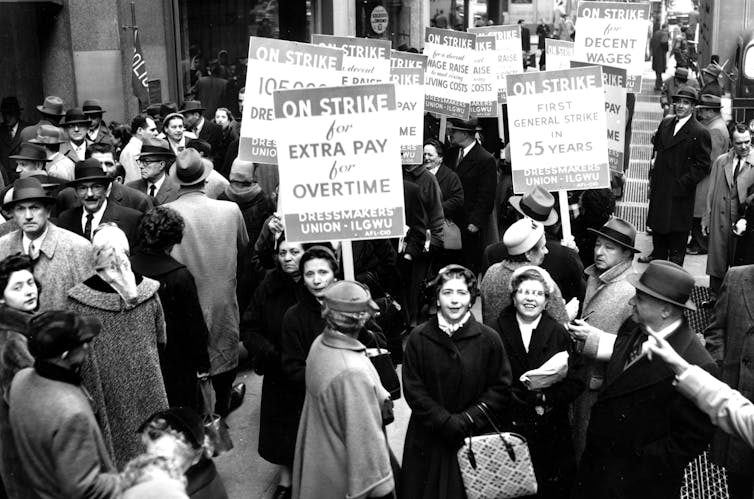
Striking members of the International Ladies’ Garment Workers’ Union in New York City in 1958. AP Photo
More than 323,000 workers – including nurses, actors, screenwriters, hotel cleaners and restaurant servers – walked off their jobs during the first eight months of 2023. Hundreds of thousands of the employees of delivery giant UPS would have gone on strike, too, had they not reached a last-minute agreement. And nearly 150,000 autoworkers may go on a strike of historic proportions in mid-September if the United Autoworkers Union and General Motors, Ford and Stellantis – the company that includes Chrysler – don’t agree on a new contract soon.
This crescendo of labor actions follows a relative lull in U.S. strikes and a decline in union membership that began in the 1970s. Today’s strikes may seem unprecedented, especially if you’re under 50. While this wave constitutes a significant change following decades of unions’ losing ground, it’s far from unprecedented.
We see the rising number of strikes today as a sign that the balance of power between workers and employers, which has been tilted toward employers for nearly a half-century, is beginning to shift.
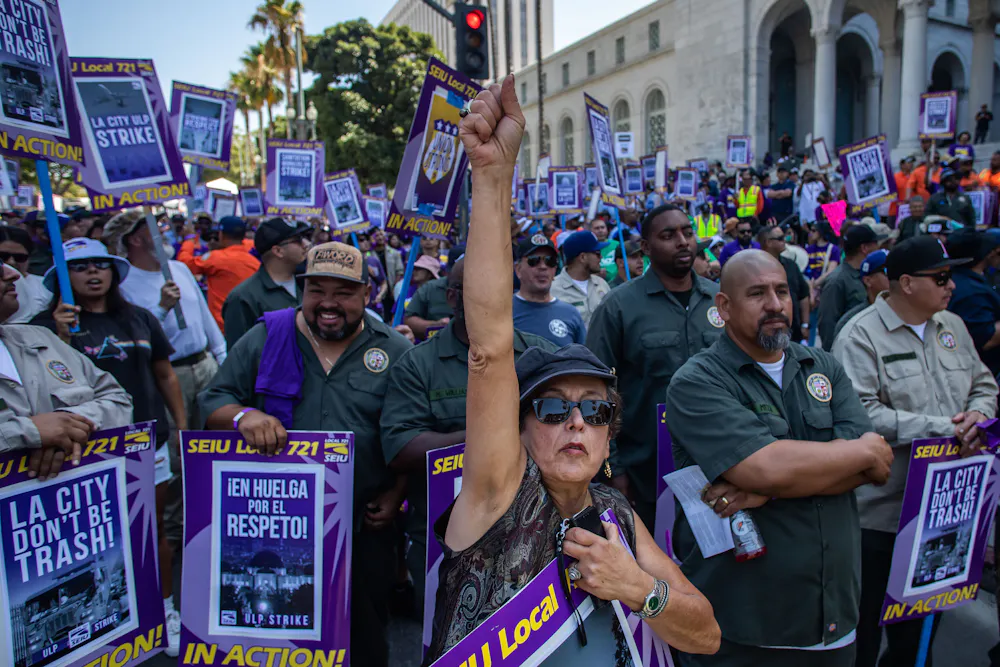
Maryam Rouillard puts her fist in the air on Aug. 8, 2023, while taking part in a one-day strike by Los Angeles municipal workers to protest contract negotiations. Apu Gomes/Getty Images
Millions on strike
The number of U.S. workers who go on strike in a given year varies greatly but generally follows broader trends. After World War II ended, through 1981, between 1 million and 4 million Americans went on strike annually. By 1990, that number had plummeted. In some years, it fell below 100,000.
Workers by that point were clearly on the defensive for several reasons.
One dramatic turning point was the showdown between President Ronald Reagan and the country’s air traffic controllers, which culminated in a 1981 strike by their union – the Professional Air Traffic Controllers Organization. Like many public workers, air traffic controllers did not have the right to strike, but they called one anyway because of safety concerns and other reasons. Reagan depicted the union as disloyal and ordered that all of PATCO’s striking members be fired. The government turned to supervisors and military controllers as their replacements and decertified the union.
That episode sent a strong message to employers that permanently replacing striking workers in certain situations would be tolerated.
There were also many court rulings and new laws that favored big business over labor rights. These included the passage of so-called right-to-work laws that provide union representation to nonunion members in union workplaces – without requiring the payment of union dues. Many conservative states, like South Dakota and Mississippi, have these laws on the books, along with states with more liberal voters – such as Wisconsin.
Wages kept up with productivity gains when unions were stronger than they are today. Wages increased 91.3% as productivity grew by 96.7% between 1948 and 1973. That changed once union membership began to tumble. Wages stagnated from 1973 to 2013, rising only 9.2% even as productivity grew by 74.4%.
When there are fewer candidates available for every open job and prices are rising, workers become bolder in their demands for higher wages and benefits.
In the 1930s, President Franklin D. Roosevelt’s New Deal enhanced unions’ ability to organize. During World War II, unions agreed to a no-strike pledge – although some workers continued to go on strike.
The number of U.S. workers who went on strike peaked in 1946, a year after the war ended. Conditions were ripe for labor actions at that point for several reasons. The economy was no longer so dedicated to supplying the military, pro-union New Deal legislation was still intact and wartime strike restrictions were lifted.
In contrast, Reagan’s crushing of the PATCO strike gave employers a green light to permanently replace striking workers in situations in which doing that was legal.
Likewise, as we describe in our book, employers can take many steps to discourage strikes. But labor organizers can sometimes overcome management’s resistance with creative strategies.
The “great resignation,” a surge in the number of workers quitting their jobs during the pandemic, now seems to be over, or at least cooling down. The number of unemployed people for every job opening reached 4.9 in April 2020, plummeted to 0.5 in December 2021, and has remained low ever since.
Technological breakthroughs that leave workers behind are also contributing to today’s strikes, as they did in other periods.
We’ve studied the role technology played in the printers’ strikes of the 1890s following the introduction of the linotype machine, which reduced the need for skilled workers, and the longshoremen strike of 1971, which was spurred by a drastic workforce reduction brought about by the introduction of shipping containers to transport cargo.
Time and again, when the conditions have been right, U.S. workers have gone on strike and won. Sometimes more strikes have followed, in waves that can transform workers’ lives. But it’s too early to know how big this wave will become.
============================================================== Alecto, Megaera, and Tisiphone, it’s not hard to see why Americans who regard life itself as a zero-sum game would be distrustful of unions (and unwilling to pay dues). What’s less easy to see is how so many Americans – citizens of a country founded on the common good – regard life as a zero-sum game. Sure, they’ve been suckered into that belief, and conservatives are certainly doing their best to make it true, because people’s belief in it benefits only the wealthy. But we didnt always think that way. Today’s authors tend to answer that question. However, the bigger question of how do we get back to sanity remains.
Yesterday, the radio opera was Richard Wagner’s “Tannhäuser,” from Beijing’s National Center for the Performing Arts (NCPA). The events of the opera have a definite historical date – during the lives of the real people Wolfram von Eschenbach and Walther von der Vogelweide, but it’s far from historical. As it starts, Tannhäuser has been living in the Venusberg (which means “the mount of Venus,” and yes, the double meaning in English also exists in German) where the goddess Venus has been keeping him satisfied for at least months if not years. The “Venusberg music” is supposed to be a bacchanale (orgy), but I certainly don’t think “orgy” when I hear it and I doubt anyone here would. Now, Saint-Saëns bacchamale from “Sanson et Dalila” is hot. Richard Strauss’s “Dance of the Seven Veils” from Salome is wicked hot. The Venusberg music is inspiring and even noble, but not hot. But Wagner’s (IMO very odd) attitudes toward sexuality don’t really come out until later. Anyway, Tannhäuser decodes he wants to go home where there are other minstrels and a girl, Elisabeth, who loves him, and he arrives just on the eve of a big singing contest, in which he is expected to participate. His entry is too erotic for everyone else, and when it comes out he has been in the Venusberg, all heck breaks loose, and Elisabeth’s uncle (the local feudal lord) in particular, but everyone really, demands he travel to Rome and get absolution from the Pope. He goes to Rome, and the Pope tells him that his staff (a piece of pretty old, very dead wood) is as likely to bear green leaves as he is to be forgiven (terrible theology, BTW). He comes back, travelling with a bunch of ordinary Pilgrims, whose chorus is very familiar outside the opera house, as is Wolfram’s song to the Evening Star, which he sings not long before Tannhäuser gets back. Tannhäuser tellsWolfram what the Pope said, Elisabeth dies (the salvation of men through the deaths of women is a very common 19th century romantic trope, it’s not just Wagner, but Wagner kind of did beat it to death), and green leaves burst out of his staff (very glad I never had to build that prop). It really is beautiful musically, which certainly saves the ridiculous (even offensive) story line. Wagner is not known for realism – his one comedy, Die Meistersinger, does actually show people with real feelings and quirks, and if you can get past the magic love potion, so does Tristan und Isolde, but mostly his characters – humans, gods, giants, dwarves, witches, dragons, birds – seem a little off. But one can get carried away by the music in spite of that.
Cartoon –
Short Takes –
Zip Recruiter – Professional Troll
Quote – As of Aug 25, 2023, the average hourly pay for a Professional Troll in the United States is $67.39 an hour. While ZipRecruiter is seeing hourly wages as high as $141.59 and as low as $5.29, the majority of Professional Troll wages currently range between $16.35 (25th percentile) to $129.57 (75th percentile) across the United States. The average pay range for a Professional Troll varies greatly (by as much as $113.22), which suggests there may be many opportunities for advancement and increased pay based on skill level, location and years of experience. Click through. It likely wil come up with information on your area. Someone at Democratice Underground found this … and found it scary. I concur.
MSN/Axios – AG Merrick Garland denounces election worker threats as DOJ charges over a dozen people
Quote – The DOJ announced Thursday that two men in two separate cases in Arizona and Georgia had pleaded guilty to threatening election officials in Arizona and Georgia in separate cases, brought by the the Justice Department’s Election Threats Task Force — which has now brought charges in 14 cases…. “The Justice Department will continue to investigate and prosecute those who target election officials and election workers as part of our broader efforts to safeguard the right to vote and to defend our democracy.” Click through for a bit more. I’m glad they are taking this seriously, and hope there are not people failng to report for fear nothing – or worse – will be done.
Yesterday, Mary Trump (Mary L. Trump, to distinguish her from her grandmother) wrote about the Supreme Court, in an essay on Substack she calls “The Lowest Court, Part 2.” She remarks, not just on the ethics issues, but on the contempt shown by the court for the people, which really is reminiscent of France before the Revolution. If you were to tell me that Alito, or Kavanaugh, or even Roberts had said “Let them eat cake,” I’d probably believe it. If you want to look deeper, here’s the link – just remember to look for the “continue reading” and click it.
Cartoon –
Short Takes –
HuffPost – Biden Administration Reveals First 10 Drugs For Medicare Price Negotiation
Quote – All told, the 10 drugs on the list accounted for $50.5 billion in total spending in Medicare’s outpatient prescription drug program for the period between June 1, 2022, and May 31, 2023, according to the Department of Health and Human Services. That’s about one-fifth of what the program, known as Part D, spent on all prescription drugs during that period. The announcement represents the first step in a process set to unfold over the coming year, with the government collecting data and public input, and then exchanging price offers with manufacturers over how much Medicare will pay for the named drugs. Click through for details. Not surprisingly, the article bears the subtitle “It’s the first step in a process that will mean lower prices in 2026 ― unless the drug industry and its allies find a way to block it.”
The Daiy Beast – How One Citizen Fought Back Against a Cop’s Road Rage
Quote – While driving home in his Ford Mustang, [New Mexico motorist Mario Rosales] legally passed a pickup truck, and the other driver started tailgating him. Road rage can be deadly, so Rosales grew concerned. No matter which way he went, the truck stayed in his rearview mirror. Rosales eventually reached his home in Roswell, New Mexico, hoping the truck would keep going. Instead, the vehicle blocked Rosales in his driveway, and the stranger behind the wheel started yelling and cursing at him. At this point Rosales was not just concerned. He was scared for himself and his family members in the house. Click through for the story, which has a happy ending – this time – finally. Too many do not.